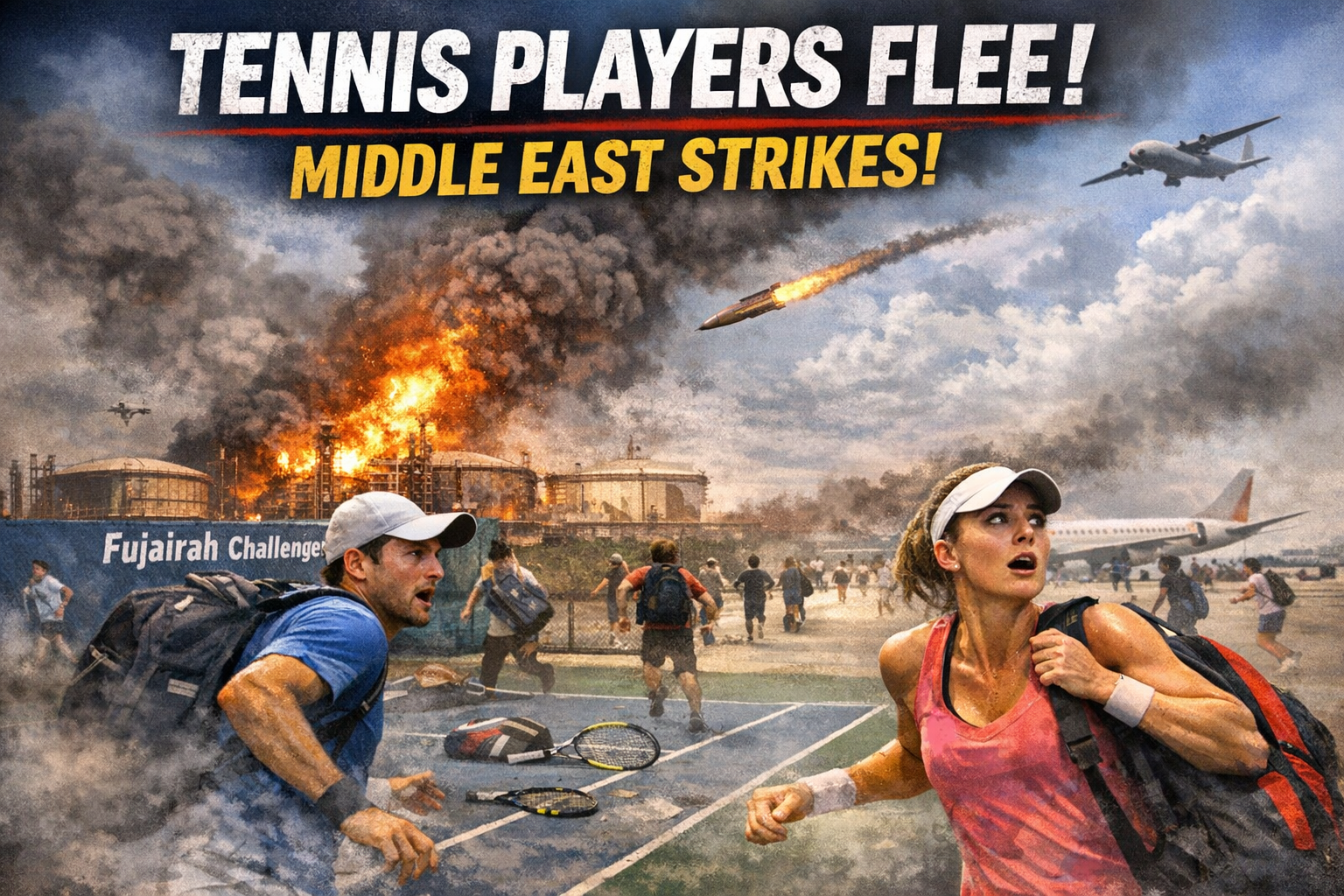
Tennis practice turned into a dash for shelter when explosions and sirens interrupted an ATP Challenger event in the United Arab Emirates.
Players in Fujairah were told the tournament was safe after discussions between the ATP and local authorities, but a drone interception that ignited a fire at a nearby oil terminal changed everything within hours.
Fujairah on edge

“The safety and wellbeing of our players, support teams and staff members remains our highest priority, and we continue to remain in close contact with those affected.”
ATP
Explosions were heard outside a Dubai hotel while players were practising roughly an hour from Dubai in Fujairah, a key oil storage and bunkering hub, and matches were suspended as officials assessed risks and scrambled to protect everyone present.
Australian James McCabe, practising on court, said: “We expected to stay in shelter because that’s what the governments were advising,” and described hearing fighter jets and explosions while wondering whether play should continue under official guidance.
The ATP initially decided to proceed after talks with local government, staging the event behind closed doors with extra security, but burning debris from the intercepted drone set an oil terminal alight and players fled the courts in panic.
Costly demands and cancelled plans
Anger rose when the tour proposed a chartered evacuation flight for players at a cost of $5,000 each, a sum that far exceeded potential Challenger rewards and prompted public pressure for the ATP to change course.
Prize money at Fujairah would have been $9,500 for the champion and $600 for a first-round loser, which underscored how untenable it was to ask lower-ranked players to fund their own escape from a dangerous situation.
After the outcry, the ATP said it would cover the chartered flight that flew to Milan via Egypt, but not every player could use that route and some, like Russia’s Marat Sharipov, were left unable to board because they lacked a European visa.
Sharipov told BBC Sport that “The ATP knew I could not travel to Europe so I think they should have said ‘we will sort something out for you’,” saying he felt abandoned when organisers did not arrange a viable alternative for him.
Players who organised their own travel were told they would not be reimbursed by the ATP, and there was no compensation for lost prize money, leaving many Challenger competitors—who often live week-to-week—facing big unexpected costs.
Aftermath and inequality
Others were offered help: the Professional Tennis Players’ Association provided $2,500 to some affected players, and the UAE reportedly covered hotel costs for those still in the country while flights and airspace remained disrupted.
Sharipov said he had spent $7,000 on cancelled flights trying to get home, and remained waiting for a confirmed route out, with a ticket to Armenia also at risk because regional airspace closures continued to cause cancellations.
The divide between top stars and challengers was stark: Daniil Medvedev and Andrey Rublev found routes via Oman and Istanbul to make Indian Wells, while lower-ranked players struggled to secure flights or appropriate assistance during the crisis.
Medvedev captured the uncertainty when he said: “No one knows when we will be able to take off,” reflecting how airspace closures and rapidly changing security assessments left organisers and players guessing about safe departures.
Many players questioned the original decision to play, with McCabe saying “I don’t understand how it was decided the tournament was safe to go to in the first place,” and criticizing the delay that meant it took about ten hours to cancel the event.
The situation highlighted how Challenger Tour players, who are often outside the top 200 and carry their own travel and equipment costs, can be most exposed when tournaments collide with geopolitical volatility and rapid security decisions.
Moving forward, players and advocates are likely to press the ATP for clearer evacuation plans and better contingency support for lower-level competitors, arguing that governing bodies must match words about safety with faster action and resources.
Join the conversation on Facebook.

Christoph Friedrich is a German tennis player and coach currently residing in Oakland, California. He began his tennis journey at the age of eight and has since dedicated his life to the sport. After working as a tennis coach and hitting partner in New York City for eight years, Christoph decided to share his knowledge and experience with tennis players around the world by creating the My Tennis Expert blog. His goal is to make tennis education accessible to everyone and help players select the best equipment for their game, from racquets and strings to shoes and overgrips. Christoph's extensive research and expertise in tennis technology make him a valuable resource for players of all levels.